The Wolf Trail is Europe’s newest thru-hike and runs from the Polish coast, through the Alps, to the Mediterranean. It is a true coast-to-coast route, taking you from northern Poland to Trieste on the Adriatic Sea in Italy, passing through forests, countryside, and mountains along the way. The trail was created by the outdoor brand Jack Wolfskin to encourage more hikers to explore these quieter and less-visited regions of Europe.
This thru-hiking trail is made up of many pre-existing but lesser-known routes, including sections of the European E-paths and numerous smaller trails across Germany. Together, they form a continuous line through a wide range of natural landscapes. The route also leads through many small villages in Poland, Germany, Switzerland, Austria, Slovenia, and Italy, offering a different view of Europe beyond the usual tourist areas. You can follow the first ambassador hikers on the trail in 2026 on our Instagram page @_thru_hiking.

The Wolf Trail is divided into seven main sections, each between 300 and 600 kilometers long, as you hike through six countries. You begin along the Polish Baltic coast, walking from Hel toward Świnoujście. This part of the trail stays flat and open, following sandy beaches, pine forests, and coastal dunes with the sea always close by. The walking feels calm and steady, giving you time to find your rhythm and settle into long daily distances. Along the way, you pass through Słowiński National Park, where large shifting dunes interrupt the regular pattern of forest and beach with their constantly moving sands that feel almost desert-like.
From Świnoujście, the route continues from the coast toward the inland lake districts. You still follow shoreline sections, crossing islands such as Usedom and passing small seaside towns with working harbors and old promenades. Gradually, the trail turns inland toward Lübeck and the Lauenburg Lakes Nature Park. The beaches give way to forests and open countryside. You now walk beside lakes and through low hills. The hiking remains easy, but the scenery becomes more varied than along the coast, with a mix of water, woodland, and farmland. In spring, you may even see young animals in the fields along the way.
Leaving Geesthacht, you move out of the northern plains and into the first real uplands. The trail leads through heathland, fields, and wooded hills as you head toward the Weserbergland and the Teutoburg Forest. You begin to notice more climbs and descents as the walking becomes a little more demanding. This section marks the end of flat terrain and the start of regular hills and daily elevation gain.
After Marsberg, the route enters a long sequence of low mountain ranges. You hike through the Diemelsee Nature Park and continue toward Winterberg and the Kahler Asten. Here, you follow parts of the Rothaarsteig, walking high above the valleys along ridge lines. The trail then crosses the Nassau Nature Park and the forested hills of the Soonwald and Nahe regions. Narrow valleys and wooded slopes guide you south toward Bad Dürkheim.
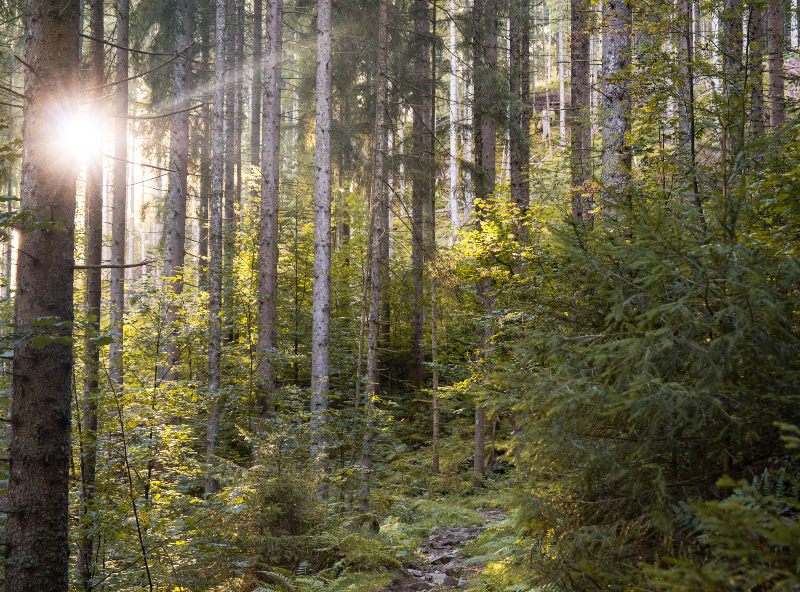
From Bad Dürkheim, the trail heads southwest toward Lake Constance in southern Germany. You cross the rocky paths of the Palatinate Forest and then continue into the Black Forest. The route passes higher points such as the Feldberg and runs through dense spruce and fir forests that are typical of the region. Eventually, you drop out of the mountains into the Lake Constance basin, where open water and distant Alpine silhouettes replace the forests you have walked through for so long. This area is often described as feeling like a Disney setting because of how scenic it is. It is a good place to take a rest and enjoy the surroundings.
From Lake Constance, the Wolf Trail enters the Alps and South Tyrol. You climb into the Nagelfluhkette, hiking through alpine valleys and small mountain villages. Here, the route links into long-distance trails such as the Via Alpina and the E5. You cross high passes and open meadows above the tree line. After so much flat and rolling terrain, it feels good to be properly in the mountains. Expect long ascents and exposed stages in this section. The walking becomes fully alpine as you approach Bolzano.
The final stretch takes you from Bolzano across the Dolomites toward the Adriatic Sea. You cross major passes in the Catinaccio and surrounding ranges, then begin a long descent into warmer landscapes. The forests thin out, the valleys widen, and Mediterranean vegetation starts to appear. You leave the high mountains behind and finish at Muggia, near Trieste, where the trail reaches the sea and the coast-to-coast journey comes to an end.
Stages / sections for section-hikers
- Stage 1: Polish Baltic Sea Coast, 428 km | 266 mi
- Stage 2: Baltic Coast to the Lake District, 543 km | 337.5 mi
- Stage 3: The Flat North to the Low Mountains, 487 km | 302 mi
- Stage 4: Low Mountain Ranges and Hills, 583 km | 362 mi
- Stage 5: Palatinate Forest to Lake Constance, 581 km | 361 mi
- Stage 6: Lake Constance across the Allgäu Alps to South Tyrol, 394 km | 245 mi
- Stage 7: Dolomites to the Adriatic Sea, 591 km | 367 mi

The Wolf Trail
Where to sleep?
Along the Wolf Trail, you will find a wide range of accommodation options. Depending on the section, you can stay in guesthouses, lodgings, mountain huts, hotels, hostels, campsites, and occasionally camp wild. The route passes through villages frequently, so you are rarely far from a place to sleep or resupply.
In regions such as Italy and Austria, mountain huts often book out well in advance and should be reserved early. If you are hiking alone or in a small group, it is sometimes still possible to get a bed by asking politely, but this should not be relied on.
Good to know
The Wolf Trail was created by the outdoor brand Jack Wolfskin. Most sections are easy to access by public transportation or by car, which makes section hiking and emergency exits straightforward. Because the route passes through many villages, towns, and cities, you can resupply food and water regularly and do not need to carry large amounts of extra supplies.
You can follow the first hikers on the Wolf Trail in 2026 on our Instagram page @_thru_hiking.
Happy trails!
Official Trail page: Wolf Trail
More on Hiking Trails: Trail Info